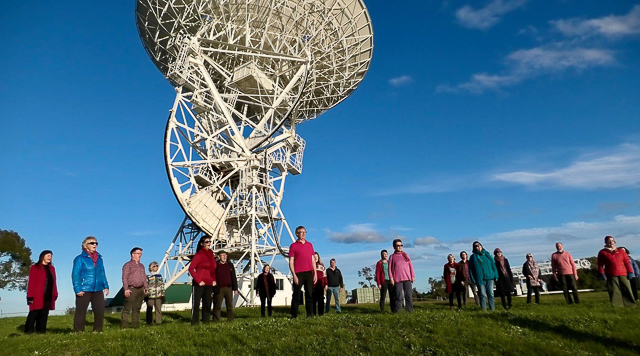
In an ironic twist, it has been discovered that the aliens from the planet that circles Vega — in the constellation Lyra — are, in fact, rabid carnivores.
(Okay, that’s slightly obscure and really pushing it. Sorry. Kind of.
)
|
|||||
|
In an ironic twist, it has been discovered that the aliens from the planet that circles Vega — in the constellation Lyra — are, in fact, rabid carnivores. (Okay, that’s slightly obscure and really pushing it. Sorry. Kind of.
They are well-written and enjoyable novels, which capture the era of the Napoleonic Wars and vividly portray life at sea in the Royal Navy. Yes, you can get sea-sick while reading them, and you’ll baulk at the thought of salt beef, ship’s biscuit and a limited ration of tainted water for dinner. The hero of the saga is, of course, the eponymous Horatio Hornblower, the self-doubting tone-deaf officer who rises through the ranks from midshipman to admiral, via a series of escapades that reveal his character. And what a leader he turns out to be. Here is a man of decisiveness, who knows how to get the best from his crew. He is a man of action, who would rather do something himself than rely on others to decide his fate. He is a man who agonises over the loss of honour that he will experience when, in his efforts to stave off further war, he lies to a French captain by saying that Napoleon has died … and he is one to whom miracles occur, because it turns that unbeknown to Hornblower, Boney had, in fact, kicked the bucket some three weeks earlier. He has compassion and, within the conventions of the day, a sense of wanting equality for the lower classes. Now I will freely confess that knowledge of how to set fore t’gallant studding sails, how to sight and range 18 pounder cannons, how to jury rig a spar as a mizzen-mast, how to kedge off a ship that has grounded, and how to rig a sea-anchor attached to the pintles of a rudder to cripple a ship* is not necessarily needed for running a country. But I reckon Hornblower would make a good PM. * Yes, you too can extend your vocabulary in a nautical direction. Just read the books. (I freely confess that the impetus for the slant taken in this review came from another blog: the coalition of awesomeness. The coalition’s current project involves nominating possible world leaders, and so far they have some excellent candidates.)
Now the fact of the matter is that the Burke and Wills expedition went nowhere near Tasmania. But when plans were mooted to place commemorative caches to celebrate the route of the expedition my brother SG-3 had a wild idea and, in the belief that Tasmania should not miss out, hatched some plans … and then, lo and behold, discovered that when Burke first arrived in Australia from Ireland he actually landed in Hobart. Thus it is that there is a Burke and Wills anniversary cache in Tasmania, and because I chanced to be in Tassie this weekend for the graduation of one of my sisters, I had the opportunity to find it on Saturday. Even better, we were able to make a serious expedition of it, since my nephew came along, plus our caching friend Snuva and her husband. There were, however, no camels. One of the nice things about this cache is that it involves a journey through the bush, and although the Tasmanian bush is a little different from its mainland counterparts (and thus to what Burke and Wills would have experienced), it was still easy to get a sense of what the expedition might have been like in the early phases. The other nice thing about this cache is that there is a completely unexpected and totally cool but appropriate surprise in the middle of nowhere thanks to my brother’s sense of the whimsical and his general creativity. Along the journey we went through all the exploring cliches we could think of (from “Are we there yet?” to “I am just going outside and I may be some time”), and generally had an enjoyable morning (oh, and we channelled the Beatles at one point). The weather, which had been miserable on Friday and had left snow on Mt Wellington, was both dry and not too cold, and so the trip was hardly arduous. And, thanks to Snuva’s thoughtful provision of lemon tarts (clearly essential supplies for any self-respecting expedition), none of us starved on the return journey. A long time ago one of my Canadian friends asked me to provide some data for her Masters thesis concerning the role of food in shaping identity and relationships and memories and … well … a whole bunch of other neo-Jungian (or something!) stuff that I didn’t entirely understand about the social role of recipes. Anyway, I wrote her a whole bunch of reminiscing bits and pieces that seemed to fit my interpretation of what she was talking about, with the typical distractions, diversions, and drivel for which my writing is notorious … and which were probably no use to her whatsoever. Anyway, I came across the file the other day, and it occurred to me that I could do a series of blogs on food memories. So, let’s set the ball rolling with spaghetti bolognese. This was a traditional and regularly cooked recipe that developed over a period of time as I was growing up. Any of us kids could make it, because it was always an easy thing to help with the cooking of it. There’d be the chopping of the onion, the frying of the mince, then a can of tomato soup and another of tomato paste to add, followed by dashes of mixed herbs, nutmeg, and sugar, after which it bubbled away to itself for a while. There is a story attached to the onion chopping. One day, in my Grade 8 cooking class, we had a written test and one of the questions asked “How do you chop an onion?” Now, I couldn’t remember having had any lessons on this, but that was okay because I had been chopping up onions for spaghetti bolognese for years. So I drew a sequence of illustrations — in glorious beautifully accurate perspective, if I do say so myself — showing the stages of onion chopping that had never failed to produce chopped up onion for spaghetti bolognese. Imagine my surprise when I got the test back with a mark of 0/6 for the onion chopping question. Of even greater concern — from an educational viewpoint — was the fact that I received no remedial teaching for onion chopping! Note well the short-comings of my education, and the pitfalls of summative assessment! I have been judged a failed chopper of onions and given no chance to redeem myself. I still don’t know how to chop onions, so I chop them the way I have always done … but secretly, so that no one knows my ignorance. When I first moved away from home and was sharing an apartment, I didn’t make the meat sauce version of spaghetti bolognese very often, but my flat-mate Lynda and I came up with a nice meatless sauce (with tomatoes … and onions!), which I still call Burnie spaghetti (Burnie was the town where we were living). I still cook this from time to time (perhaps even more often than the traditional family recipe), and it brings back memories of my Burnie days. The secret with this recipe is to let the tomatoes stew for ages … and then (oh, I just remembered!) there is Lynda’s great way of checking if the spaghetti is cooked. You simply throw a piece against a brick wall: if it sticks, it’s ready! This necessitates the existence of a brick wall, which, fortunately, our apartment had, otherwise we might have starved. I’ve since learned to make brick-wall-free judgements about the readiness of pasta … but I do miss the satisfaction of tossing the spaghetti! An ordinary work day, with some other odds and ends squished in, and then circumstances conspired — relatively dramatically — to prevent me from getting to the Scout AGM that I was supposed to be running. So here’s the day: not quite the celebratory twelfth 12 of 12 I might have wanted, but the set of photos captures the day’s reality near enough.
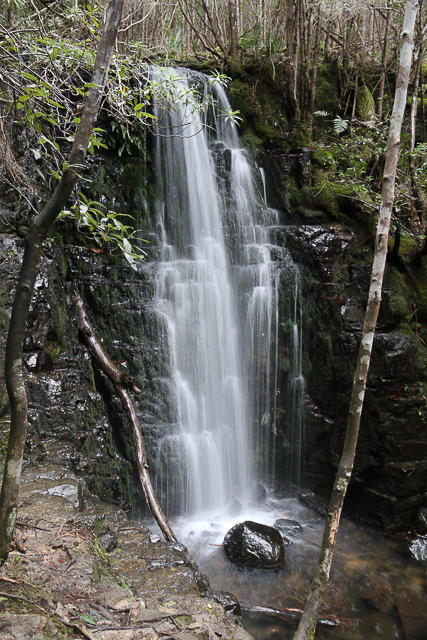
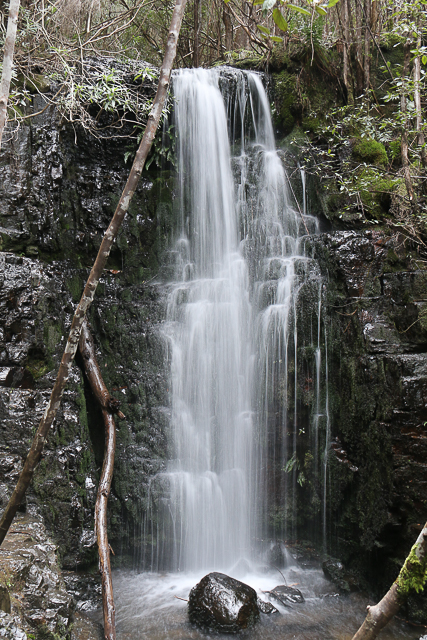
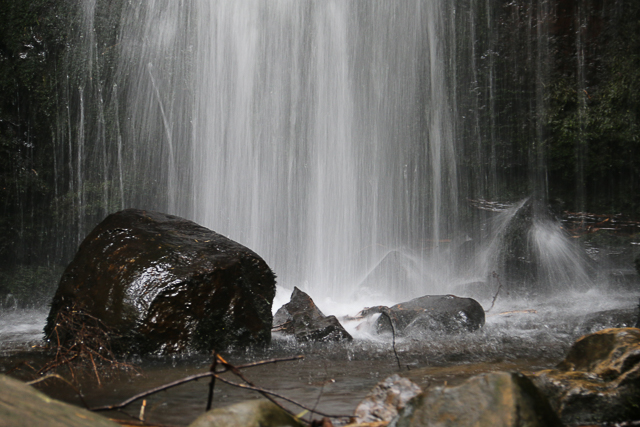
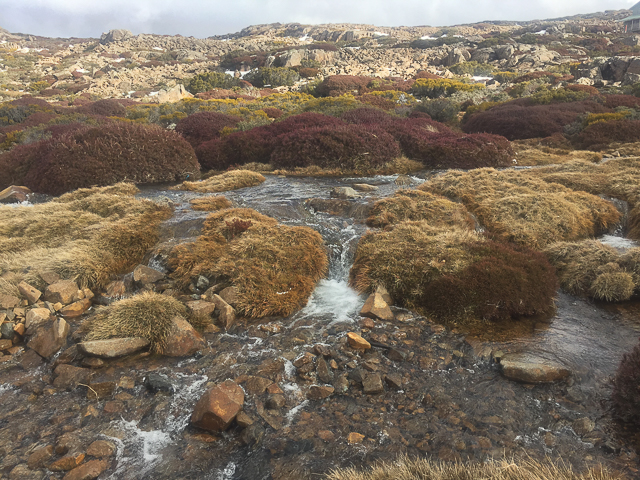
One of the highlights, for me, was the half-day leisurely hike we did on Saturday to a gully in the bush a couple of kilometres from the campsite. I’ll confess there were a couple of geocaches in the vicinity, which were what prompted the walk … but without them I’d never have known about the place. The gully is formed by a little creek that has cut its way through the conglomerate rock (a conglomerate is a sedimentary rock type where the rock is actually made up of pebbles that have fallen into a matrix of fine sand and then it’s all been solidified**). There were big boulders (one of the Scouts nearly managed to strand himself on top of one), and a little ravine where the creek had gouged deeply into the rock to create the valley. At the top end of the track the bush opened up, and there were some striking outcrops and tiny trickles of waterfalls over the little escarpments, sort of like an Australian version of what I imagine Swallowdale to look like***. Anyway, we had an enjoyable time exploring the area, clambering over the small cliffs and following the creek in its rock-cutting course to the top of one of the falls (see photo at right, although the water is all but invisible). We then set aside the GPSrs, got out the more traditional compasses and I had the Scouts navigate back to camp directly over the hill through the bush. There was a typical tendency for the lie of the land to “pull” everyone off course, and I confess I used my GPSr to nudge us back towards the correct direction … but the Scouts actually did quite well with their navigation, especially considering the density of the bush and the steep terrain. *Family in-joke: this was used by us kids to describe any geological feature we came across, with the urgent requirement being to name the feature as such before Dad had a chance to start telling us its real name, life history, chemical composition, Mohr hardness, bank account details, etc, etc. ** Bother. I was supposed to say it was a geomorphic intrusion of the upper cleft palate. I can’t hide the fact that I am my father’s daughter. *** From the second book in the Swallows and Amazons series by Arthur Ransome. 1. If everything is working fine, then it won’t be after you upgrade. 2. There WILL come a point when you cannot put off upgrading any longer. Theorem: If everything is working fine then there WILL come a point where everything is not working fine. Proof: If everything is working fine, then Axiom 2 says there will come a point when you will have to upgrade … despite the fact that everything is working fine (this will also happen even if everything is NOT working fine, but that’s irrelevant to our proposition). Axiom 1 then implies that things will not be working fine afterwards. QED. Alternatively, you could have the proof by one example*: my computer was fine six weeks ago. The last few days have not been fun. * Such a “proof” by example is not a proof at all, but it’s the one that seems most convincing to the average citizen. It’s certainly been mighty convincing for me. Ljubljana is an enjoyable city to visit. Slovenia — the only one of the ex-Yugoslavian republics to be part of the European Union — is a small country of only 2 million or so people, and Ljubljana, its capital, is a comfortably-sized 300,000. There is a small river running through the centre of Ljubljana, and the cobbled streets of the old city are bordered by some lovely old and not so old buildings. There is a castle on the hill overlooking the city, and you can walk up the paths through the trees to the top (only it was a hot July week and even first thing in the morning (which is when I made this journey) it was very muggy) or you can take a little funicular cable-car thingy. There are lots of restaurants along the river and by the main square, and it was very pleasant to be there in the evening. It’s a place that caters well for tourists without feeling too touristy (actually I suspect the Global Financial Crisis had rather reduced tourist numbers this summer), with good signage and with most hotel and restaurant staff speaking English. There is a sense of Eastern European dourness among the denizens, exacerbated by the strong accent, but there’s also an undercurrent of dry humour: as a non-coffee drinking tee-totaller in a country with a well-regarded wine industry I think I rather bemused the waiter one night because of what I wasn’t having, but he assured me that by the end of the night he would have figured out my vice! Unfortunately for him, I knew that I’d been eating way too much while travelling, and consequently I’d sworn off desserts for the night.
The conference program included a half-day excursion on Wednesday afternoon, and the one I selected involved heading out into the Slovenian karst country (karst is a particular kind of limestone landscape, featuring caves and sinkholes and so forth). This turned out to be a good choice for a variety of reasons, not least of which was that it was a stinking hot day, thus making being inside caves even more appealing than usual. The first place we visited was Predjamski Grad (Predjama Castle). This is built up against and into a cliff face that is riddled with caves. These caves contain remains of fortifications and tunnels that predate the 16th century castle buildings. The photo at right shows the castle and cliff, together with what I presume is a tilt-yard for jousting in the foreground (I’m not sure if this is authentic or a restored remnant of something authentic or a later addition for the gratification of contemporary tourists). The site was occupied by the knight/robber baron Ezerem Lueger in the 15th century, and he used the cave system to escape from the castle site out into the country-side to fetch food. Legend has it that he was betrayed by one of his men, who gave away the site of the lavatory into which the opposition bombarded a cannon-ball or stone from a trebuchet/catapult thingy thus killing poor unfortunate Ezerem and provoking snickers from the extremely sensitive and compassionate tourists to whom this story was told. (Between the vagaries of legend and the unreliability of my memory, any resemblance between this account and the actual facts of the matter is purely a fluke … apart from the bit about the snickers, which is definitely true.) The photos below show other parts of the castle and cave. The seccond of the two photos looks out of the entrance visible above the castle in the photo above right, and there is a passageway disappearing back up into the hillside behind where I was standing to take the photo. Although it was very pleasant inside on this warm summer day, apparently it was not much fun to be a resident in winter time. Our other stop was at nearby Postojnska Jama (Postojna Cave). This massive limestone cave is one of the biggest in Europe. It’s so big that there’s a “little” electric train (kind of like a set of rollercoaster carriages, carrying about 60 people at a time) that takes you in the first 4km or so. Then there’s a walking tour of about 1km or so through caverns and passages, with all the usual limestone cave formations (including a spaghetti ceiling of tiny white stalactites). The second last stop of the walk is the cavern in the first of the photos below, which houses a big aquarium (barely visible in the lower middle part of the photo) containing a few specimens of “human fish”, which is a blind, white salamander kind of thing about 25cm long which is native to the caves in the area (technically it’s an Olm or a Proteus). The final stop before boarding the train for the journey back out was the massive cavern shown in the second photo, which is so huge it has apparently hosted concerts with audiences of up to 10000 (OH&S rules mean the permitted number is now only about 5000). You can just make out people and their shadows/reflections in the far distance, as well as the two near people on the right. Time constraints meant that we were a little rushed, but it was an interesting afternoon.
In a rather convoluted way all of this explains why it is that the 12th of the month, while falling on a working Monday, sees me somewhere other than my messy office or my messy house. Instead I had conference sessions during the day (while suffering a miserable cold that started rearing its ugly head just as I was leaving Australia), and then in the early evening we finished up in part of historic Ljubljana down by the river beneath the castle for dinner in one of the outdoor restaurants. It has been very warm across Europe, which, while making the cold feel even more horrible, has at least made it very nice to eat out. Anyway, the 12 of 12 photos are here, with extra explanations as usual. |
|||||
|
Copyright © 2010 Off into the sunset … - All Rights Reserved |
|||||
Latest comments